The old email address is not the new employee
A documentation-based Insacheck review of mailbox access, retained messages and the address-reuse waiting period.
An Insacheck feature review commissioned for brand information, dated 29 October 2026. This is not an independent customer testimonial. The purchasing-team example below is hypothetical; no employee mailbox was deleted or transferred in preparing this article.
A purchasing assistant leaves, and the replacement happens to have the same first name. Reusing the familiar email address might look like a convenient handover. It is also an easy way to confuse three different things: the former employee's access, messages the company needs to retain, and the address assigned to the next person.
Insacheck's documented mailbox policy makes that distinction worth reviewing before an administrator clicks Delete. The relevant question is not simply "Can the old employee still sign in?" It is "Which information, address and access right are we changing?"
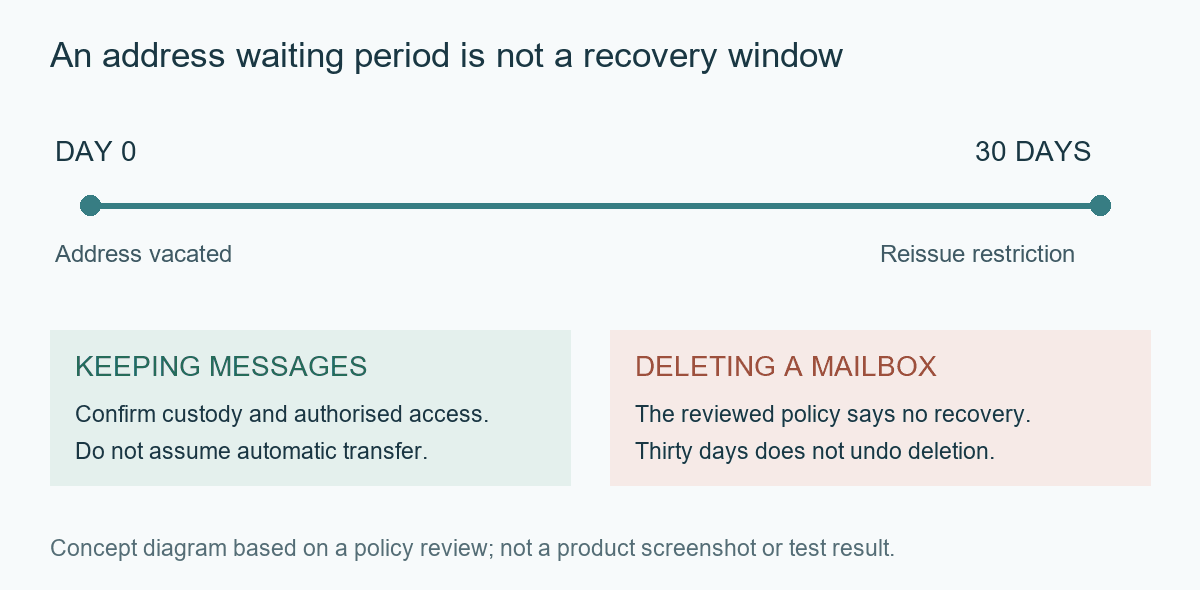
Original policy-review diagram, not a product screenshot. The waiting period is an address policy, not a backup or recovery promise.
A restriction on reissuing an address is not an archive
The company-mail section of Insacheck's published mailbox policy says that a deleted mailbox and its messages cannot be recovered. It also states that addresses deleted or vacated through a departure process are not issued to another employee for 30 days. Those are separate rules with very different consequences.
The address restriction provides a stated period during which an old address is not immediately handed to someone else. It does not say that a deleted mailbox remains recoverable during those 30 days. Nor does it establish that messages will automatically appear in a replacement employee's mailbox afterwards.
For the hypothetical purchasing team, the safest reading is therefore not "delete today, recover if needed next week." The company should settle its legitimate business-record requirements before deletion, and verify the supported method of providing any authorised handover access.
Review the decision in three parts
| Decision | What the reviewer should establish | What the policy does not prove |
|---|---|---|
| End the former employee's access | The actual departure status and the resulting mailbox-access state | A future departure date entered in a record has already closed access |
| Retain necessary correspondence | The company's authorised custodian, purpose, retention need and supported access route | Every manager or successor automatically inherits the old mailbox |
| Delete or later reuse an address | The deletion warning, the address restriction and the actual available issue controls | Deletion is reversible, or the address transfers automatically on day 31 |
These are review questions, not a claim that Insacheck exposes a single three-step handover wizard. The public company-mail material connects mailbox access with employee status, but an organisation still needs to check its real account roles and the handling of remaining mail.
Why a date in an HR record is not enough evidence
The dated product reference distinguishes an active employee with a future departure date from a completed departure. In other words, a calendar date and the effective access state should not be treated as synonyms. This is a documentation and code-reference observation, not a live claim that a particular employee has been blocked.
Before a real departure, the administrator should verify the employee's actual status, the intended cutover time and which supported interface confirms mailbox access. An authorised test should use a controlled account and avoid exposing real employee correspondence. If records disagree, resolve that uncertainty before declaring the offboarding complete.
Two mistakes this review would avoid
First, I would not tell a successor to use the former employee's personal login. A business need to continue supplier correspondence is not itself permission to impersonate another person. Issue the successor's own account and confirm any supported company-controlled handover route separately.
Second, I would not promise a three-year searchable archive or a legal-hold facility from the existence of a retained-mailbox description. I have not verified the retention duration, successor access, audit detail or export coverage needed for that requirement. A team with a mandatory long-term archive should obtain the relevant policy and demonstrate the required behaviour before choosing its workflow.
There is also a smaller but practical edge case: after the waiting period, an address may become eligible for a later issue action, but this review has not established the precise release-time calculation, timezone or automatic assignment behaviour. Do not advertise a guaranteed midnight transfer.
Where Insacheck fits in this decision
The useful feature to evaluate is the relationship between an employee's company record and company-mail administration, together with explicit warnings about address reuse and deletion. That can support a more deliberate departure checklist. It is not a substitute for deciding who should keep business correspondence or for testing the access rights that a handover actually requires.
For a small team, I would put one approval checkpoint before mailbox deletion: confirm that the appropriate person has reviewed the needed correspondence and the supported preservation arrangement. Treat that checkpoint as the company's procedure, not as an automated Insacheck approval feature. The address can wait; an irreversible deletion should not be used as a test of whether the handover worked.
Evidence basis: public Insacheck terms checked on 29 October 2026, public company-mail descriptions and a 21 October 2026 product-reference snapshot. This is a feature and policy review, not legal advice, a measured customer outcome or proof of live mailbox recovery. Policies and available interfaces can change.
